DMX vs TTL - Which Pixel Lighting Protocol Fits Your Project?
2025-07-19
Compare DMX512 and TTL LED Control Systems
When it comes to programmable LED pixel lighting, choosing the right control system is just as important as selecting the right fixtures. In pixel-based LED systems, the control protocol directly affects signal stability, resolution, wiring complexity, and overall scalability. Two of the most common control protocols used in architectural, decorative, and stage lighting are DMX512 and TTL (SPI) —they offer distinct advantages depending on installation size, pixel density, and system architecture.
Both systems are widely supported and offer powerful control capabilities, but they differ in performance, scalability, and use-case suitability. In this article, we'll explore the key differences between DMX and TTL and help you determine which is better suited for your lighting project. At Shenzhen Ledcolourlight, we specialize in high-performance pixel lighting products, including 3D pixel strings, LED strips, pixel point light, pixel tubes, and neon flex, all compatible with DMX, TTL(SPI).
Both systems are widely supported and offer powerful control capabilities, but they differ in performance, scalability, and use-case suitability. In this article, we'll explore the key differences between DMX and TTL and help you determine which is better suited for your lighting project. At Shenzhen Ledcolourlight, we specialize in high-performance pixel lighting products, including 3D pixel strings, LED strips, pixel point light, pixel tubes, and neon flex, all compatible with DMX, TTL(SPI).
Understanding the Basics: What Are DMX and TTL?
—— DMX512
DMX512 is a professional digital communication protocol originally developed for stage lighting. It allows for precise, reliable control of lighting fixtures over long distances via standard XLR or waterproof connectors. It operates over RS-485 cables, and each DMX universe can control up to 512 channels, with each channel typically representing one control value (like the Red, Green, or Blue level of an LED, 170 RGB pixels per DMX line).
Key Features of DMX:
1. Long-distance signal transmission (up to 300m with proper cabling)
2. Stable communication in complex environments
3. Supports daisy-chaining and multi-universe expansion; multiple universes can be synced for large installations
4. Compatible with most lighting consoles and media servers (e.g., GrandMA) for precise dimming and effects
Cons
✖ Wiring Complexity: Requires daisy-chained connections and terminators.
✖ Limited Refresh Rate: The default 44Hz refresh rate.
✖ Wiring Complexity: Requires daisy-chained connections and terminators.
✖ Limited Refresh Rate: The default 44Hz refresh rate.
—— TTL (SPI, Signal-Based Control)
TTL is a simpler, signal-based control method used in addressable LED strips and pixel lights, such as WS2811, UCS1903, TM1814, etc. It transmits data using a signal line (sometimes along with a clock line) and is best for shorter runs or direct connections to LED controllers or microcontrollers.
Key features of TTL:
1. Suitable for short to medium distances (typically up to 10~20m)
2. Cost-effective and simple wiring
3. Higher frame refresh rate and smoother animations for small setups
4. Supports more pixels per output channel (depending on the controller)
Cons
✖ Short Range: Signal degrades beyond 10–20m without signal boosters.
✖ No Error Correction: Data corruption can cascade if one pixel fails. {Some TTL pixel systems adopt a 4-wire design (power, ground, data, backup data), like WS2818, SM16703, and UCS7604 that supports breakpoint signal resume. If one pixel fails,
✖ Short Range: Signal degrades beyond 10–20m without signal boosters.
✖ No Error Correction: Data corruption can cascade if one pixel fails. {Some TTL pixel systems adopt a 4-wire design (power, ground, data, backup data), like WS2818, SM16703, and UCS7604 that supports breakpoint signal resume. If one pixel fails,
the backup signal line allows data transmission to continue, enhancing system reliability for complex or critical installations.}
DMX vs. TTL: A Feature Comparison
| Feature | DMX512 | TTL (SPI) |
| Max Distance | ~ 300m (wired) | ~ 10–20m (wired) |
| Cable Structure | 3 wires (DMX+, DMX-, GND) / 4 wires with a ADDR | 2 wires (Data, GND) / 3 wires (Data, GND, Backup Data) |
| Control Resolution | 8-bit | 8-bit / 16-bit |
| Refresh Rate | 44 Hz | 1,000+ Hz |
| Signal Integrity | Very stable | Sensitive to interference |
| Maximum Number of RGB Pixels | 170 | > 1000 |
| Cost | Slightly higher (controller + wiring) | More economical for small projects |
When to Use DMX Lighting Control
DMX is ideal for large-scale, professional, or long-distance lighting installations where stability and expandability are essential.
Use DMX for:
1. Concert stages and live shows
2. Large building facades
3. Multi-zone architectural lighting
4. Complex 3D lighting structures
✅ Product Match: 50mm RGB 3D Pixel Tube (1.0m, 144 LEDs, 24 Pixels, Milky White, Available in Various Lengths)
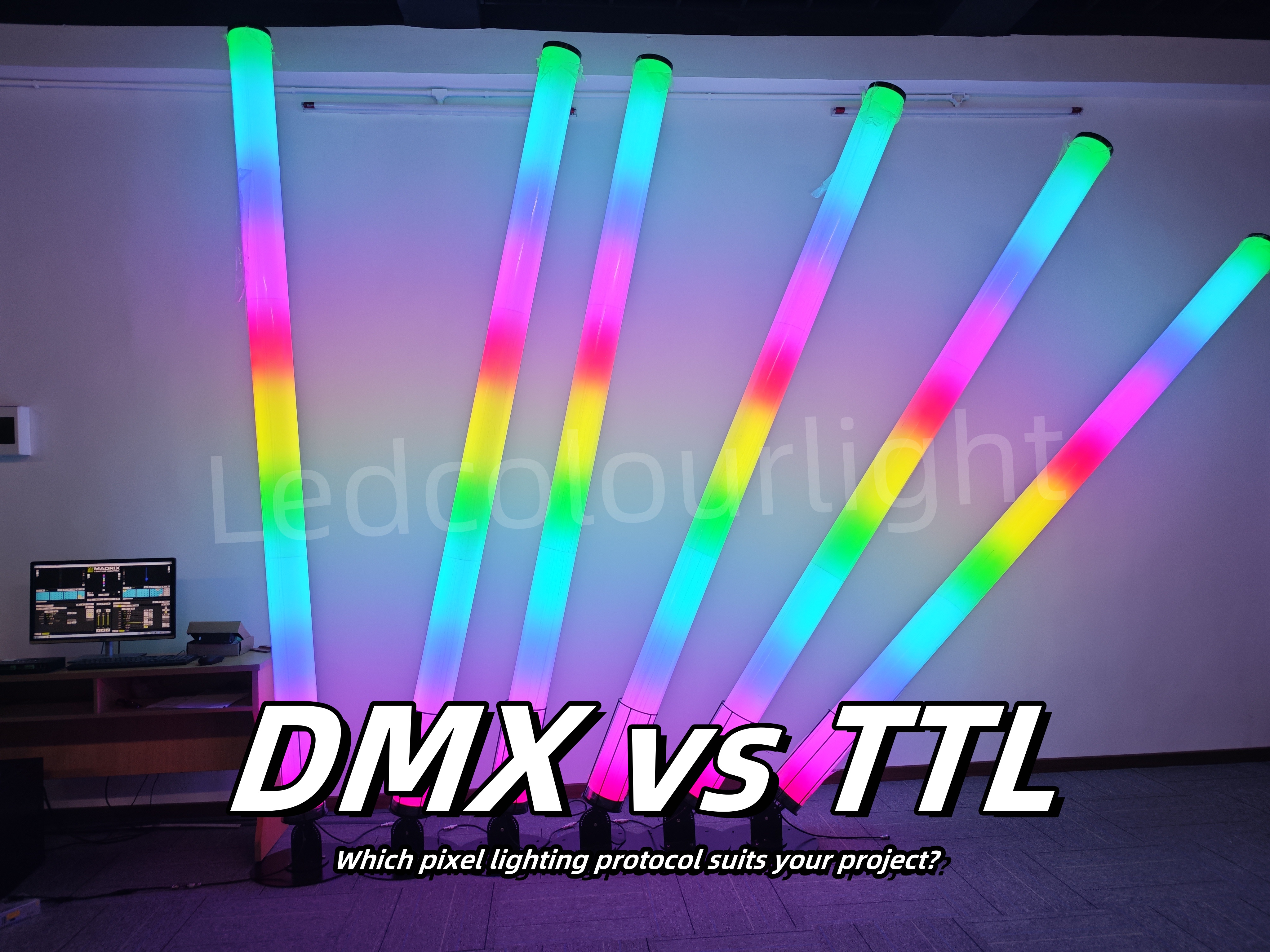
This best-selling 50mm RGB 3D pixel tube is an excellent match for DMX control systems, especially in large-scale and complex lighting environments. The milky white PC diffuser ensures soft, uniform 360° illumination—perfect for creating elegant visual effects with rich color transitions. With DMX control, each of the 24 pixels (6 LEDs per pixel) can be precisely programmed for high-impact animations, making it ideal for professional show setups or installation art.
This best-selling 50mm RGB 3D pixel tube is an excellent match for DMX control systems, especially in large-scale and complex lighting environments. The milky white PC diffuser ensures soft, uniform 360° illumination—perfect for creating elegant visual effects with rich color transitions. With DMX control, each of the 24 pixels (6 LEDs per pixel) can be precisely programmed for high-impact animations, making it ideal for professional show setups or installation art.
The upgraded version features dual-end M10 mounting rods, enabling flexible multi-angle connections using ball joints. This allows designers to build custom 3D structures such as pyramids, cubes, and spatial grids. Powered and controlled via DMX512, each pixel tube delivers precise, reliable performance for stage productions, immersive installations, and professional architectural lighting setups.
When to Use TTL Lighting Control
TTL is more suitable for small to medium projects, or when budget and simplicity are top priorities. It's also great for compact decorative installations where short cable runs are enough.
Use TTL for:
1. Interior decor and ambient lighting
2. Interactive displays and booths
3. Holiday and festival installations
4. Short pixel strips or small fixtures
✅ Product Match: Addressable Pixel Strip (RGB LED Tape)
This flexible RGB pixel strip is ideal for TTL control systems. Compact and lightweight, it offers high-resolution pixel control in a slim form factor, making it perfect for contour lighting, signage, or interior decorative accents. TTL control allows for smooth animations with simple wiring—perfect for cost-effective, creative lighting designs in tight spaces.
This flexible RGB pixel strip is ideal for TTL control systems. Compact and lightweight, it offers high-resolution pixel control in a slim form factor, making it perfect for contour lighting, signage, or interior decorative accents. TTL control allows for smooth animations with simple wiring—perfect for cost-effective, creative lighting designs in tight spaces.
✅ Product Match: 10mm Pixel LED String (Dot Light Series)
The 10mm pixel string light offers a compact solution for dense, decorative lighting layouts. Each node is addressable via the TTL protocol, allowing for vibrant color changes, chasing effects, and soft gradients across the string. Its small size and lightweight build make it ideal for holiday displays, interior decor, or interactive installations where space is limited but impact is essential.
The 10mm pixel string light offers a compact solution for dense, decorative lighting layouts. Each node is addressable via the TTL protocol, allowing for vibrant color changes, chasing effects, and soft gradients across the string. Its small size and lightweight build make it ideal for holiday displays, interior decor, or interactive installations where space is limited but impact is essential.

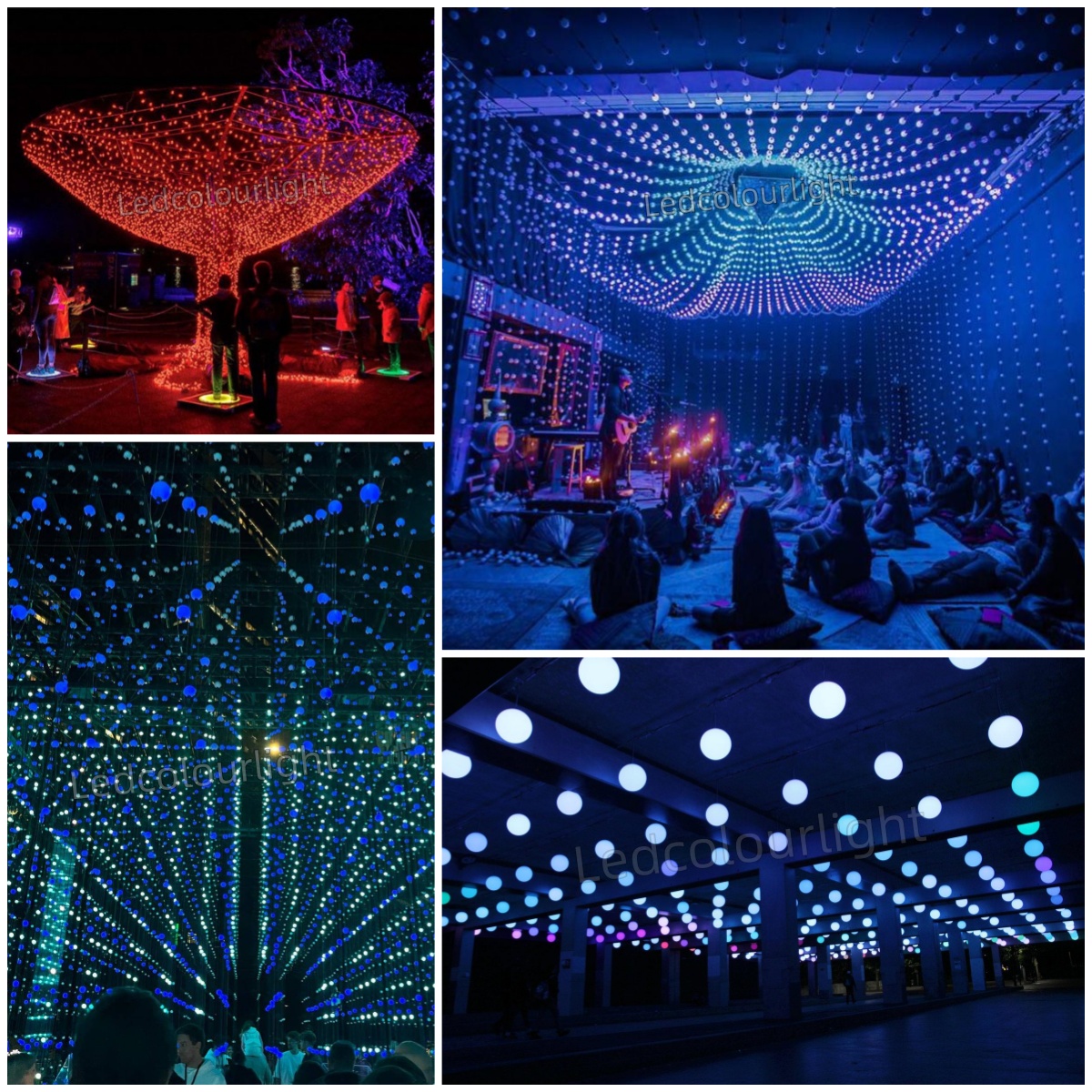
Pixel Lighting Product Compatibility Overview
| Product | DMX Compatible | TTL Compatible | Notes |
| 3D Ball String Light | ✅ | ✅ | Ideal for curtain-style or cluster effects |
| Pixel Dot Light | ✅ | ✅ | Suitable for building facades and media walls |
| Flexible Pixel Strip | ✅ | ✅ | Great for contour or linear animations |
| Neon Pixel Flex | ✅ | ✅ | Soft-bendable, good for signage and ambient borders |
| 30mm Pixel Tube | ✅ | ✅ | Dual control support, good for 3D structures |
| Linear Light Bar | ✅ | ✅ | Outdoor or architectural lighting |
| 50mm 3D RGB Tube | ✅ | ✅ | Ideal for immersive and structural lighting with soft diffusion |
| 10mm Pixel LED String Light | ❌ | ✅ | Perfect for Christmas, Halloween or 3D pixel mapping settings |
| Pixel COB LED Strip (Magic Color) | ❌ | ✅ | Smooth, seamless effect; best used in interior and signage lighting |
| Eaves Light String | ❌ | ✅ | TTL-only, ideal for rooflines and decorative edges |
| C7/C9 RGB Bulb String Light | ❌ | ✅ | Common for U.S.-style holiday lighting, supports only TTL |
| Amusement Park Game Lights | ❌ | ✅ | TTL is cost-effective for large-volume installations like rides and kiosks |
Installation and Maintenance Considerations
DMX requires terminators at the end of each universe to avoid signal reflection. (optional)
TTL signal may degrade quickly over long cables; use signal amplifiers or shorter distances.
For both systems, waterproof connectors, T-cables, and mounting accessories are available to simplify outdoor or 3D structure assembly.
Our team can provide customized connection diagrams, control mapping, and accessory kits for either system based on your layout and design needs.
Conclusion: Which Control System Should You Choose?
There's no one-size-fits-all answer. The right control system depends on scale, complexity, distance, and budget:
Choose DMX if you're building a professional-grade installation, require long-distance data transmission, or plan to synchronize across multiple zones.
Choose TTL if you're working on a budget-friendly or small-scale project, need faster refresh rates, or have limited installation space.
Need help designing your pixel lighting system? We offer both off-the-shelf products and full control solutions for DMX and TTL-based setups.
Contact us to discuss your project and get tailored advice!
✉️ Email: [info@ledcolourlight.com]
☎️ WhatsApp: [+86 158 1374 3157]
☎️ WhatsApp: [+86 158 1374 3157]
RGB WS2811 Lights Strip - Versatile, Waterproof, Pixel-Controlled
Raindrop LED Lights - Immersive Lighting for Events and Creative Installations
Related Article
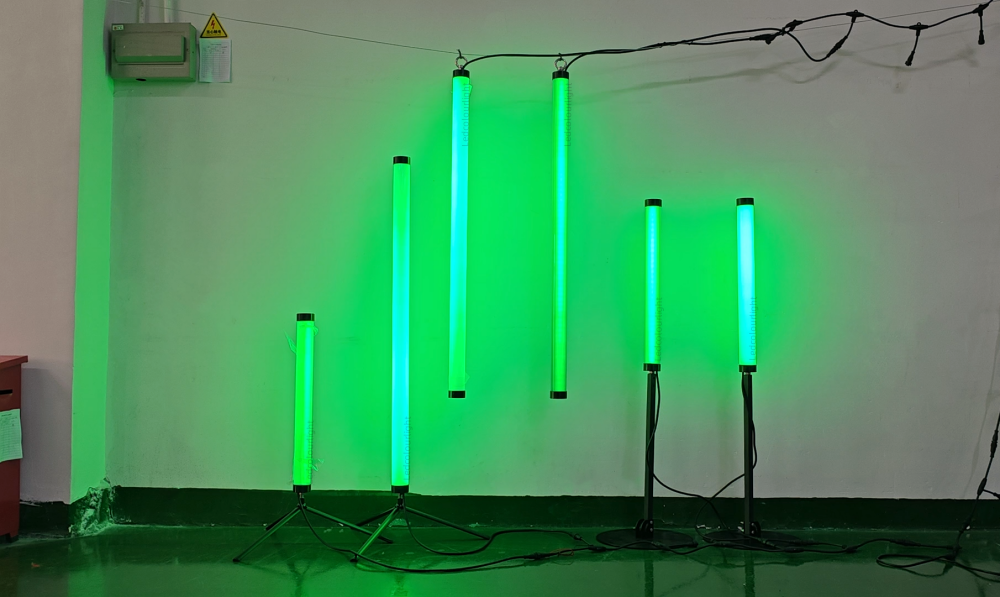
This article explores a versatile 3D LED light tube developed for multi-project use, offering adaptable installation methods and consistent performance for professional lighting environments.
Pixel-controlled 3D LED Light Tube for Professional Lighting Projects