How to Pick the Best Voltage for Pixel Lighting
2025-09-25
Power & Installation Guide for Pixel Lighting — Choosing Between DC 5V, 12V, and 24V
A correct power design is as important as the pixels themselves. Choosing DC 5V, 12V, or 24V affects wiring layout, voltage drop, installation flexibility, and long-term reliability. Learn how to prevent LED voltage drop with expert tips on power supply design, cable selection, and injection for 5V, 12V, and 24V systems.
Introduction for LED Voltage Drop
LED voltage drop is the #1 enemy of stunning, professional-grade lighting installations. You've spent hours perfecting your pixel led design, only to see it ruined by LEDs at the end of the run dimming or turning yellow instead of brilliant white. This common issue, known as voltage drop on LED strips and strings, occurs when the electrical current travels a long distance, causing a loss of power and a drop in voltage.
Understanding and combating voltage drop on LED systems is not just technical—it's essential for achieving the vibrant, consistent illumination your project deserves. This comprehensive guide will walk you through the causes and provide practical solutions based on power supply design, cable selection, and strategic power injection, with a special focus on the key differences between 5V, 12V, and 24V systems.
Understanding and combating voltage drop on LED systems is not just technical—it's essential for achieving the vibrant, consistent illumination your project deserves. This comprehensive guide will walk you through the causes and provide practical solutions based on power supply design, cable selection, and strategic power injection, with a special focus on the key differences between 5V, 12V, and 24V systems.
Understanding the Root Cause of LED Light Voltage Drop
Voltage drop is an inevitable physical phenomenon: as current flows through wires or PCB traces, the copper's inherent resistance converts part of the electrical energy into heat, reducing the voltage available further down the line. In LED pixel systems, this drop has a direct impact on performance. A pixel designed for 5 V may shine brightly at its rated voltage, but if only 4 V reaches it, the LED will appear dim and may misinterpret data signals, leading to inaccurate colors, flicker, or even failure under full-white output.
The effect is governed by a simple relationship:
Total current (I) = number of pixels × current per pixel (A).
Round-trip resistance (R_total) = 2 × (one-way length) × R_per_meter_of_wire.
Voltage drop (V_drop) = I × R_total.
Remaining voltage at load = V_supply − V_drop.
Because the percentage drop is larger at lower supply voltages (e.g., 5 V systems), even small resistance can cause significant issues. This is why proper voltage selection, adequate wire gauge, and power injection are critical design considerations in LED lighting systems.
The effect is governed by a simple relationship:
Total current (I) = number of pixels × current per pixel (A).
Round-trip resistance (R_total) = 2 × (one-way length) × R_per_meter_of_wire.
Voltage drop (V_drop) = I × R_total.
Remaining voltage at load = V_supply − V_drop.
Because the percentage drop is larger at lower supply voltages (e.g., 5 V systems), even small resistance can cause significant issues. This is why proper voltage selection, adequate wire gauge, and power injection are critical design considerations in LED lighting systems.
Typical Per-pixel Currents & Product Examples
Below are typical reference numbers used in practical design. Always use actual datasheets for final design.
◎ 5V addressable pixels (WS281x type) — typical peak current per pixel (full white) ≈ 60 mA (20 mA per channel × 3).
◎ 12V “Christmas” pixel light strings — many designs group LEDs so each “pixel” is formed of 2~3 LEDs + driver; per-pixel current often still ≈ ~60 mA but grouping changes wiring strategy.
◎ 24V DMX tube light / point light strings — often use LED groups (e.g., 6 LEDs per pixel) with per pixel current around 60 mA (design dependent).
So while the per-pixel current can be similar across systems, the system voltage and wiring scheme determine how current flows and how severe the voltage drop impact is.
◎ 5V addressable pixels (WS281x type) — typical peak current per pixel (full white) ≈ 60 mA (20 mA per channel × 3).
◎ 12V “Christmas” pixel light strings — many designs group LEDs so each “pixel” is formed of 2~3 LEDs + driver; per-pixel current often still ≈ ~60 mA but grouping changes wiring strategy.
◎ 24V DMX tube light / point light strings — often use LED groups (e.g., 6 LEDs per pixel) with per pixel current around 60 mA (design dependent).
So while the per-pixel current can be similar across systems, the system voltage and wiring scheme determine how current flows and how severe the voltage drop impact is.
Example Calculations (to illustrate LED light voltage drop)
Assume: wire resistance per meter (typical copper):
0.5 mm² ≈ 0.034 Ω/m
1.0 mm² ≈ 0.0175 Ω/m
2.5 mm² ≈ 0.0074 Ω/m
Scenario A — 100 pixels, 60 mA each → total I = 6.0 A.
Round-trip length for 5 m one-way = 10 m.
Round-trip length for 5 m one-way = 10 m.
Using 1.0 mm²: R_total = 10 × 0.0175 = 0.175 Ω.
V_drop = 6 × 0.175 = 1.05 V.
V_drop = 6 × 0.175 = 1.05 V.
As % of 5V supply: 1.05/5 = 21.0% (severe — unacceptable).
As % of 24V supply: 1.05/24 = 4.4% (acceptable).
Using 0.5 mm²: R_total = 10 × 0.034 = 0.34 Ω.
V_drop = 6 × 0.34 = 2.04 V → 40.8% on 5V (disastrous).
V_drop = 6 × 0.34 = 2.04 V → 40.8% on 5V (disastrous).
Using 2.5 mm²: R_total = 10 × 0.0074 = 0.074 Ω.
V_drop = 6 × 0.074 = 0.444 V → 8.9% on 5V, 1.85% on 24V (good for 24V).
V_drop = 6 × 0.074 = 0.444 V → 8.9% on 5V, 1.85% on 24V (good for 24V).
Takeaway: the same conductor and current cause a much larger percentage drop at 5V than at 24V. That's why higher-voltage systems are preferred for long runs.
The Critical Choice: Comparing 5V, 12V, and 24V LED Pixel Systems
Your first and most important decision in preventing LED light voltage drop is selecting the correct operating voltage. Each has distinct advantages and challenges.
1. 5V LED Pixel Lights (e.g., 5V 12mm Bullet Pixels)
5V 12mm bullet pixel strings, dense pixel arrays with WS2812/WS2811 family.
Advantages
Advantages
- Fine pixel control, high density, compact pixel modules.
- Common for close-view decorative lighting and short runs (< 5 m from PSU).
Disadvantages
- Extremely sensitive to voltage drop—even small wiring resistance causes a large percentage loss and visible dimming.
- Not recommended for long daisy-chained runs without multiple power injection points. (Require frequent power injection)
When to use
Short installations, indoor decorative strings, and small signage, where power injection is easy and run lengths are short. Maximum recommended run without injection: 30-40 pixels (3-4 meters).
Short installations, indoor decorative strings, and small signage, where power injection is easy and run lengths are short. Maximum recommended run without injection: 30-40 pixels (3-4 meters).
2. 12V LED Pixel Lights (e.g., 12V Christmas Pixel Light Strings)
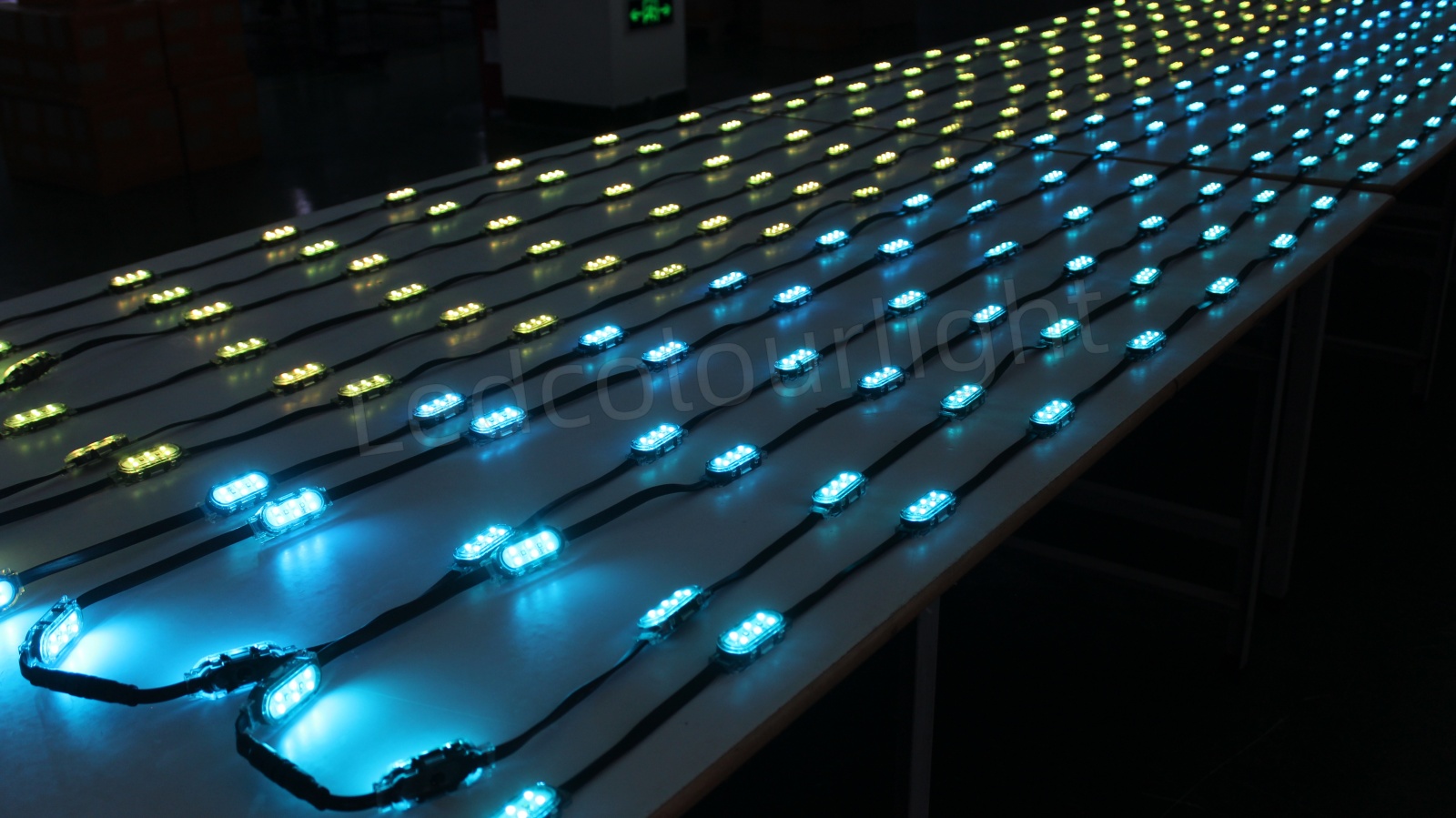
12V pixel Christmas lights, often grouped LEDs per pixel.
Advantages
Advantages
- A great balance of performance and practicality.
- Better tolerance to voltage drop than 5V. A drop of 1-2V is less impactful percentage-wise, allowing for longer runs between power injection points.
Disadvantages
- Intermediate complexity: longer runs still require power injection and thicker leads for high pixel counts.
- Many 12V pixels use a design where one IC controls a small group of 3 or 4 LEDs. If there's a slight drop, the entire group might be affected.
When to use
Medium-size facade lighting, decorative border lighting, projects where compromise between pixel density and run-length required. Maximum recommended run without injection: 50-60 pixels (5-6 meters).
3. 24V LED Pixel Lights (e.g., 24V DMX LED Tube & High-Output Strips)
Advantages
- Best for long runs: voltage drop has a smaller percentage effect; allowing for extremely long runs with minimal power injection.
- More efficient power distribution (lower current for same power), enabling thinner long-distance trunk cabling. This significantly reduces wiring complexity and cost for massive projects.
- Often used for high-power, high-brightness pixel LED design and professional installations.
Disadvantages
- Requires step-down if end equipment expects lower voltages; some pixel ICs designed for 5V/SPI need different driver topology.
When to use
Long runs, outdoor facades, big pixel installations, and when you want minimal voltage drop and fewer injection points. Maximum recommended run without injection: 100+ pixels (10+ meters).
Practical Wiring & Installation Guidelines
1. Estimate the total current early. Use per-pixel current × pixel count to size PSUs and wire gauge.
2. Limit one-way run length for low-voltage systems. For 5V, keep the distance from the PSU to the first pixel very short (< 2–3 m).
3. Use multiple power injection points. For long strings, inject power every N pixels (e.g., every 5–10 m depending on gauge and pixel density).
4. Choose an appropriate wire gauge. When in doubt, upsize the conductor. A 2.5 mm² trunk line dramatically reduces V_drop versus 0.5 mm².
5. Consider higher supply voltage + local DC-DC converters. Use 24V trunk lines and small 24→5V DC-DC converters near pixel clusters — combines benefits of long-run efficiency and 5V pixel compatibility.
6. Use quality waterproof connectors and sealed terminations. Outdoor connectors must match IP ratings and not be the weak point for water ingress.
7. Add fusing & surge protection. Protect long runs with appropriate fuses at injection points and surge protectors for outdoor sites.
8. Test the first string before mass production. Produce a first-string sample, confirm brightness/uniformity, and measure voltage at endpoints, then approve for bulk production.
2. Limit one-way run length for low-voltage systems. For 5V, keep the distance from the PSU to the first pixel very short (< 2–3 m).
3. Use multiple power injection points. For long strings, inject power every N pixels (e.g., every 5–10 m depending on gauge and pixel density).
4. Choose an appropriate wire gauge. When in doubt, upsize the conductor. A 2.5 mm² trunk line dramatically reduces V_drop versus 0.5 mm².
5. Consider higher supply voltage + local DC-DC converters. Use 24V trunk lines and small 24→5V DC-DC converters near pixel clusters — combines benefits of long-run efficiency and 5V pixel compatibility.
6. Use quality waterproof connectors and sealed terminations. Outdoor connectors must match IP ratings and not be the weak point for water ingress.
7. Add fusing & surge protection. Protect long runs with appropriate fuses at injection points and surge protectors for outdoor sites.
8. Test the first string before mass production. Produce a first-string sample, confirm brightness/uniformity, and measure voltage at endpoints, then approve for bulk production.
Troubleshooting LED Light Voltage Drop
If you observe dimming or color shifts at the far end:
- Measure voltage at the start and end of the run (with full white). If V_end is significantly lower, you have a voltage drop issue.
- Add a mid-run power injection or increase conductor size.
- Check connectors and solder joints — high-resistance joints cause extra drop and heat.
- For 5V systems, consider shortening runs or adopting distributed powering strategy (multiple local PSUs).
Recommendations per Product Type
1. 5V 12mm Bullet Pixel String: Use only for short runs or installations with frequent power injection. Keep cable runs short; use thicker leads where possible.
2. 12V Christmas Pixel Lights String: Good for decorative outdoor runs around a building where moderate distances occur. Still plan power injections every 8–10 m depending on pixel density.
3. 24V DMX Tube Lights / Point Light String: Best for long facade runs or big installations. Use 24V trunk power and inject closer to pixel groups when necessary. Consider local buck converters for any 5V-only pixels.
2. 12V Christmas Pixel Lights String: Good for decorative outdoor runs around a building where moderate distances occur. Still plan power injections every 8–10 m depending on pixel density.
3. 24V DMX Tube Lights / Point Light String: Best for long facade runs or big installations. Use 24V trunk power and inject closer to pixel groups when necessary. Consider local buck converters for any 5V-only pixels.
Final Thoughts
Power design is not an afterthought — it is integral to successful pixel installations. Understanding the voltage drop and how it scales with supply voltage, current, and cable resistance helps you pick the right voltage (5V, 12V, 24V) and wiring architecture. Use higher supply voltages for long runs, plan power injection points, size conductors properly, and always prototype a first string to verify real-world behavior before mass production.
If you'd like, we can run a site-specific calculation for your layout (number of pixels, run lengths, chosen wire gauge, and supply voltage) and propose the optimal power injection plan and PSU sizing.
If you'd like, we can run a site-specific calculation for your layout (number of pixels, run lengths, chosen wire gauge, and supply voltage) and propose the optimal power injection plan and PSU sizing.
Professional Christmas String Lights with DMX512 Control for Creative Designs
How to Choose IP Ratings for Outdoor Waterproof LED Lights
Related Article
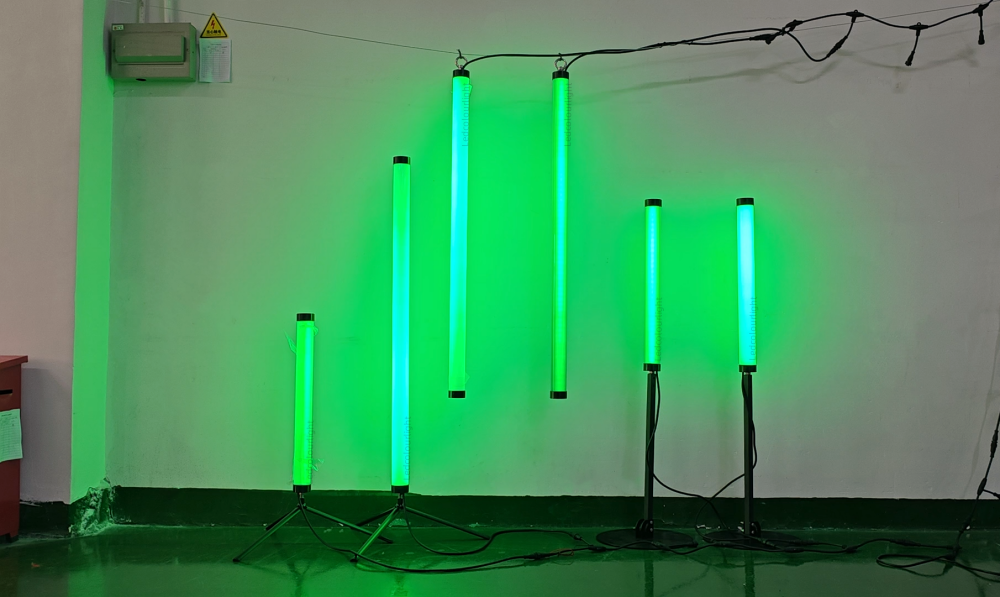
This article explores a versatile 3D LED light tube developed for multi-project use, offering adaptable installation methods and consistent performance for professional lighting environments.
Pixel-controlled 3D LED Light Tube for Professional Lighting Projects