The Difference between LED Strip Lights and Light Bars
2025-03-19
What is the Difference between LED Strip Lights and Light Bars?
When it comes to lighting solutions for nightclubs, theme parks, or architectural silhouettes, LED strip lights, and light bars are two popular choices, each offering unique features and applications. Understanding the differences between them can help you choose the right lighting fixtures for your needs. LED strip lights are flexible, bendable, thin, and can be cut to custom lengths. They are ideal for creating seamless lighting in curved or irregular spaces, such as under cabinets, along staircases, or along tree installations. Light bars are rigid and come in fixed lengths. They are more suitable for straight-line applications, such as outdoor architectural silhouette decoration or lighting festival LED Tunnel.
LED Strip Light Overview and Types :
LED light strips are an advanced lighting solution that integrates LED chips into a cohesive unit, typically consisting of lamp beads, a circuit board (a protective housing, and an adhesive backing, both of which depend on the type of light strip you purchase). These versatile products are categorized based on their distinct characteristics and application needs, as follows:
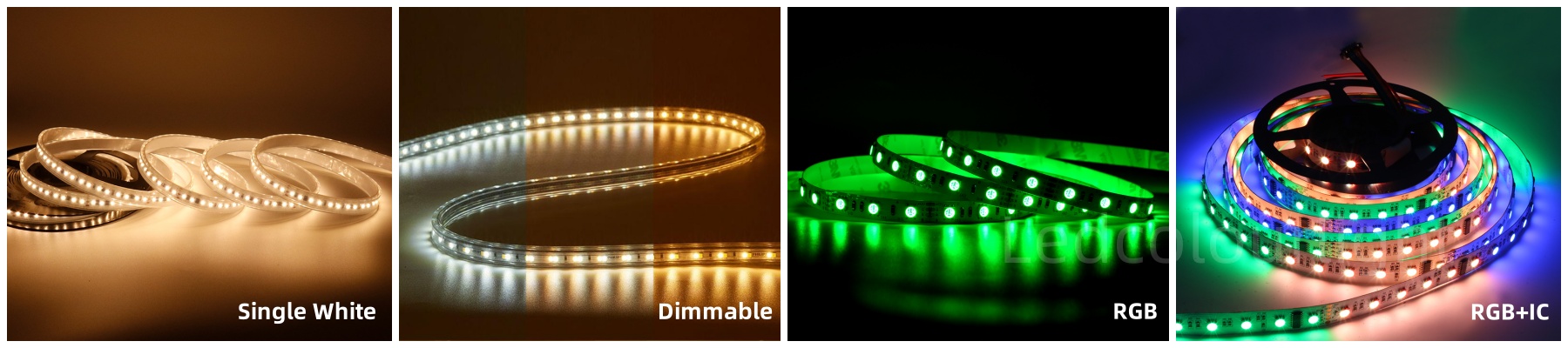
- Single-color LED Light Strips: These light strips emit a single, consistent color, providing uniform illumination for a variety of environments. For example, amber LED strips, blue light strips, etc.
- Adjustable Color Temperature Light Strips: Featuring the capability to shift between warm and cool white tones, these strips achieve color variation through voltage modulation or external control systems.
- RGB / RGBW Multicolor Light Strips: These light strips offer a variety of colors and adjustable brightness that can be precisely managed via a dedicated controller, remote device, or smartphone app.
- Programmable Digital Light Strips: Incorporating individually addressable LED beads, these advanced strips can create complex lighting patterns, textual displays, and animated effects when paired with specialized control units. Emitting colors are available in single white ( 3000K~6000K ), RGB, or RGBW.
This classification system enables users to select the most appropriate LED light strip technology for their specific lighting requirements and creative applications.
Other Light Strip Types :
-
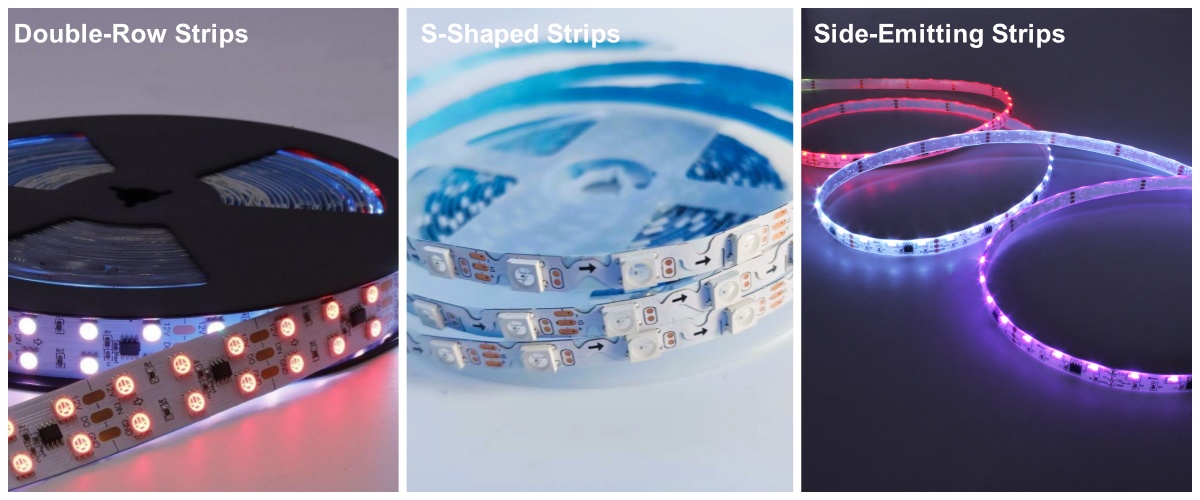
Multi-Row Strips: Multi-Row LED strips feature two or more rows of LEDs on a strip, providing a larger light source and higher brightness than single-row strips. They are used in applications that require high illumination.
-
Side-Emitting Strips: They are designed to project light to the side, rather than upward. This makes them suitable for installations where the strips need to be hidden, such as under shelves or along edges.
-
S-shaped LED strips: They are designed with a unique zig-zag or serpentine pattern, allowing them to bend and curve more easily than standard straight LED strips. This makes them perfect for applications requiring sharp turns, intricate designs, or irregular surfaces.
* Additional Knowledge Insertion
SMD and COB Strip Lights
SMD (Surface Mount Device):
SMD LED strips mount individual LED chips onto a flexible circuit board. They are known for their versatility and are available in a variety of chip sizes, such as 2830, 3528, and 5050. SMD LEDs emit a narrower beam angle than COB LEDs, making them ideal for applications that require focused lighting.
COB (Chip on Board):
COB LED strips consist of multiple LED chips mounted directly onto a single substrate or circuit board. This configuration provides a continuous and uniform light output without visible LED spots. COB LEDs have a wider beam angle and high light efficacy, uniform light color, and high brightness, making them more efficient.
SMD LED strips mount individual LED chips onto a flexible circuit board. They are known for their versatility and are available in a variety of chip sizes, such as 2830, 3528, and 5050. SMD LEDs emit a narrower beam angle than COB LEDs, making them ideal for applications that require focused lighting.
COB (Chip on Board):
COB LED strips consist of multiple LED chips mounted directly onto a single substrate or circuit board. This configuration provides a continuous and uniform light output without visible LED spots. COB LEDs have a wider beam angle and high light efficacy, uniform light color, and high brightness, making them more efficient.
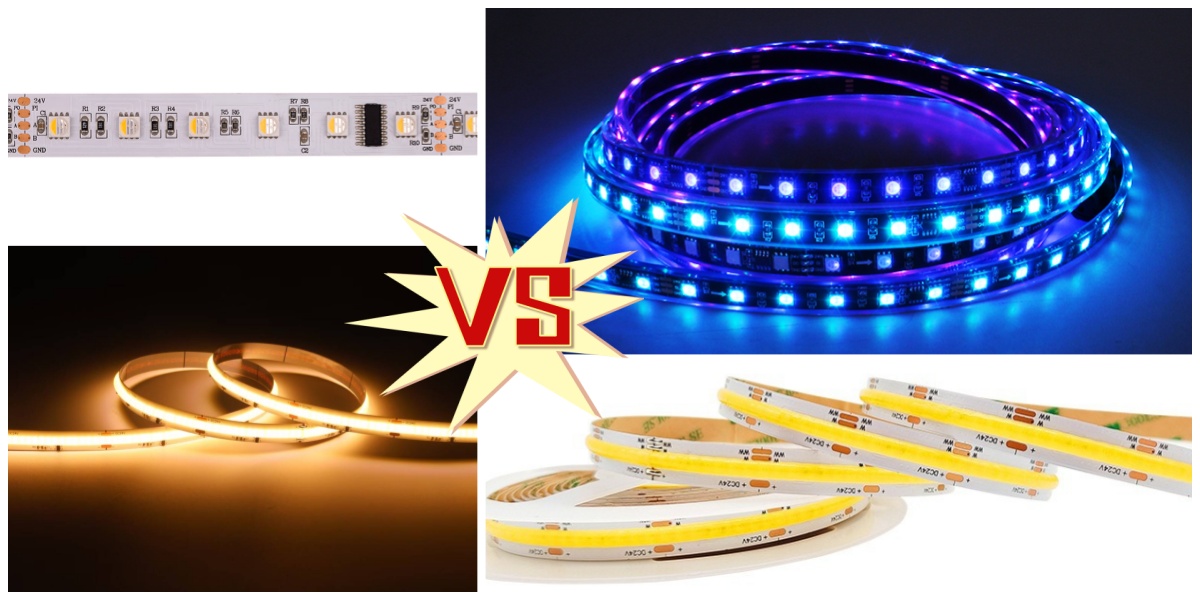
More detailed information about SMD LED light strip and COB light strip please browse the next article.
More Information on Choosing the Suitable Flexible Light Strip
1. PCB color of Strip Light
PCBs come in two basic colors: black and white. The light strips feature a black PCB, which helps them blend into dark surfaces. This feature makes it suitable for installation in places where the light strip is not noticeable when not in use, such as in theaters or dark-themed interiors
2. LED Strip's Density and Brightness
LED strip density (measured in LEDs per meter) directly affects brightness and power consumption. Higher-density strips are brighter but use more power. For example, a strip with 60 LEDs per meter is much brighter than a strip with 30 LEDs per meter but uses more power.
The choice of density depends on the intended use:
-
High-density strips ( 120 ~ 144 LEDs/meter ): Great for task lighting or areas that require intense lighting
-
Medium-density strips ( 60 ~ 96 LEDs/meter ): Good for general ambient lighting
-
Low-density strips ( ≤ 30 LEDs/m ): Good for accent lighting or subtle visual effects
3. IP Rating of LED Strip
For different installation scenarios, Ledcolourlight provides different IP ratings for your project.
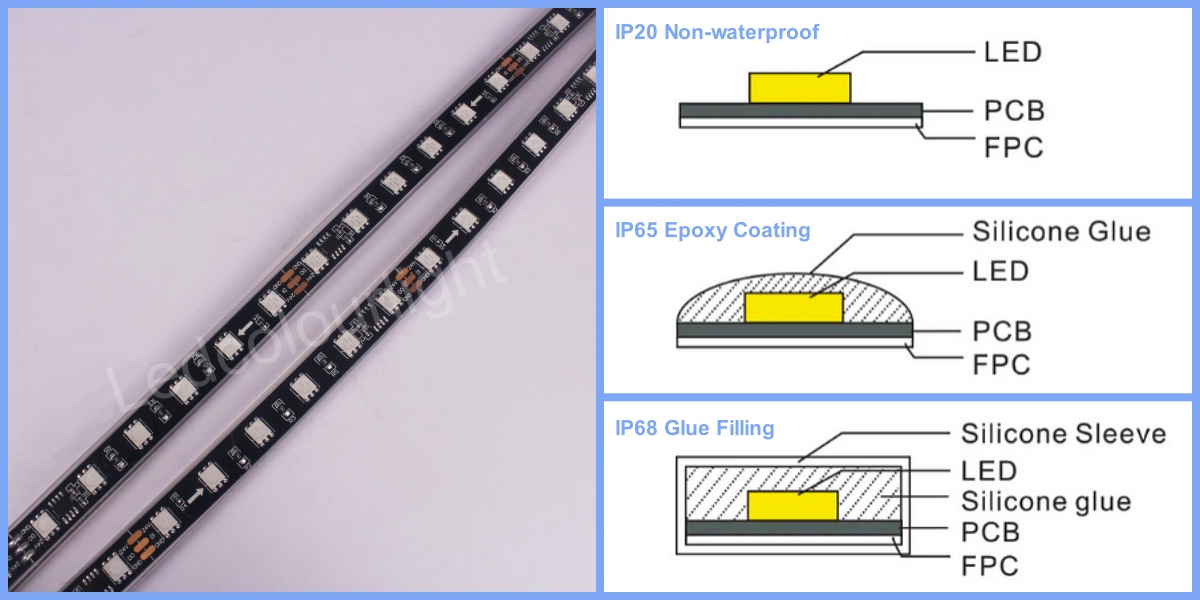
- IP20: Not waterproof, 3M adhesive backing, suitable for dry indoor environments
- IP65: Protected against splashing water, silicone tube covered or surface epoxy, suitable for wet areas
- IP68: Provides continuous immersion protection, silicone tube filled with glue, ideal for water environments
4. Voltage and Power Requirements
LED strips are usually powered by a 12V or 24V DC power supply.
12V strips: More common and compatible with a wider variety of power supplies. However, they are more susceptible to voltage drops over long distances.
24V strips: Better suited for longer installations due to reduced voltage drops, resulting in more consistent brightness across the strip.
When selecting a power supply, it is critical to match the voltage of the LED strip and ensure adequate power. It is common to select a power supply with a capacity 20% higher than the total power of the LED strip to meet peak demands and ensure longevity.
5. Are LED Light Strip Cuttable?
Yes, LED light strips are usually designed to be cut at certain points, allowing you to customize the length to your needs. Most LED light strips have marked cut lines, usually indicated by a scissor icon or a line.
Tips for Cutting LED Strips
Always cut the strip when it is unplugged to avoid electrical hazards.
Double-check the cut marks to ensure you're cutting in the right place.
For RGB or addressable LED strips, ensure the cut does not disrupt the data line, as this could affect functionality. For the Ledcolourlight light strip with 60 LEDs per meter, it's 3 LEDs per cut ( DC12V type ), and 6 LEDs per cut ( DC24V type).
Always cut the strip when it is unplugged to avoid electrical hazards.
Double-check the cut marks to ensure you're cutting in the right place.
For RGB or addressable LED strips, ensure the cut does not disrupt the data line, as this could affect functionality. For the Ledcolourlight light strip with 60 LEDs per meter, it's 3 LEDs per cut ( DC12V type ), and 6 LEDs per cut ( DC24V type).
6. Different ways to install LED light strips
1. Paste directly on the decorative surface, making sure the surface is clean and dry before doing this
2. Use silicone clips and screws to install light strips on the surface
3. Paste the light strip on the aluminum channel and use the milky white diffuser to get a mixed light color effect.
LED Light Bar Overview and Types:
A linear light bar is a type of LED lighting fixture characterized by its long, narrow design that provides continuous, uniform illumination across a straight line. Straight and solid aluminum housing for durability and heat dissipation. Brackets or screws are required for installation, providing greater stability. Available in various lengths to meet your project requirements, .
1. Different Housing Options for LED Light Bar
Ledcolourlight provides linear strip lights in different sizes, such as 20*10mm, 27*25mm, 23*25mm, 25*40mm, or 37*47mm, and the housing color can be original color or black. They also come with different diffusers to suit different project needs. Such as transparent, milky white, or black PC cover. Acrylic diffusers are also available for even lighting effects, regular size is 0.5m, 1m.

2. LED Quantity of Pixel Light Bar
Ledcolourlight equips our linear light strips with 48, 60 LEDs per meter or double rows of LEDs, assembled on PCB boards for wider aluminum housings, such as 37*47mm or 50*64mm, for stronger lighting output. 3 LEDs or 6 LEDs in a group, pixels are controlled individually, and multiple light bars can create animations, texts, etc.
3. IP Protection for Light Bar
-
IP45 dustproof, suitable for indoor nightclubs and bar decoration
-
IP65 rainproof, suitable for outdoor buildings and bridge decoration
-
IP68 glue filling, suitable for near water environment
4. Control Method of Digital Light Bar
Ledcolourlight has standard DMX512 controllable linear light bars and SPI controllable types, such as WS2811, UCS1903, etc. 3 LEDs or 6 LEDs as a group, they can show a variety of lighting effects by using an LED controller or Art-Net controller.
In summary, LED light strips are highly flexible, bendable, thin, and cuttable, making them a cost-effective alternative to linear light bars. LED light bars feature a sturdy, straight design with superior dust and moisture resistance. Both LED light strips and light bars have their own unique advantages and are suited to different application scenarios. Selecting the right product based on your specific needs is essential to maximize its lighting performance.
At Ledcolourlight, we provide comprehensive customization services to meet your project requirements. As a professional manufacturer of pixel lighting fixtures since 2014, we are always ready to listen to your ideas and design innovative solutions tailored to your needs. If you have further questions about LED lighting or require assistance, please feel free to reach out—we're here to help!
COB LED Strip or SMD LED Strip
What is RGB Lighting?
Related Article
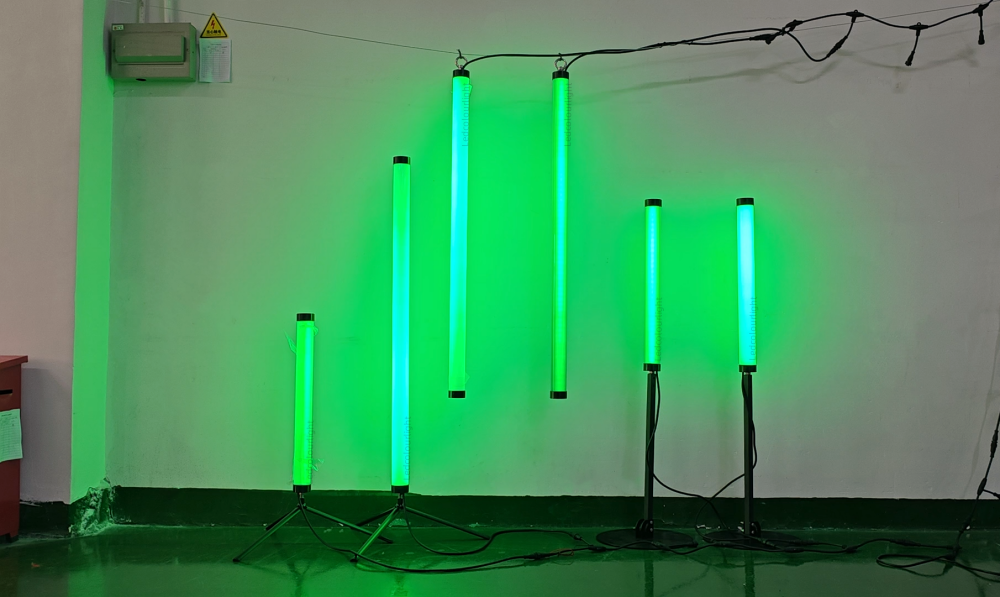
This article explores a versatile 3D LED light tube developed for multi-project use, offering adaptable installation methods and consistent performance for professional lighting environments.
Pixel-controlled 3D LED Light Tube for Professional Lighting Projects